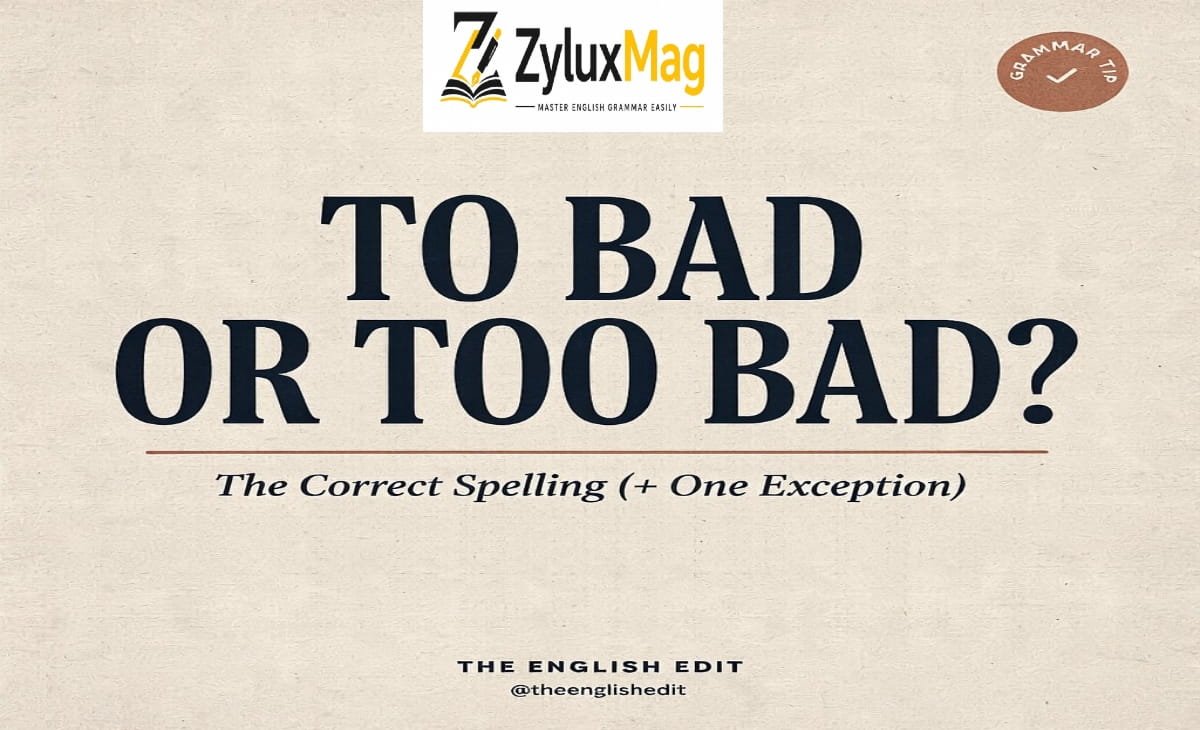
Correct: “Too bad.” This is used when referring to something being unfortunate or regrettably so. Example: “That’s too bad you missed the concert.” “To bad” would be incorrect. “To” can’t modify an adjective.
The Exception: You might find “to bad” used when “bad” modifies a following noun. For instance, “exposed to bad weather.” In this case, the usage is correct, and has a totally different sentence construction.
When I’ve Made This Mistake… And Learned My Lesson
A few years ago, I wrote an email to a client: “it’s to bad we missed the deadline”-and literally thirty seconds after sending, I had this sinking stomach feeling. I clicked to open the email and just stared at my sent messages, desperately willing the missing ‘o’ to appear, but no, the typo stared back at me. The client never mentioned it, but I noticed she started CCing her senior editor on all her responses after that. This small ‘o’ cost me nothing other than a moment of extreme humiliation, but it sure did teach me to read over any email, even the short, informal ones, an extra time before hitting ‘send’. The sentences we always miss are these simple ones.
Why “Too Bad” is Correct (and “To Bad” Isn’t)
So many of us get “too” and “to” mixed up because they sound identical when you say them. In print, however, they’re words with completely different functions.
“Too” is an adverb. One of its main jobs in language is to strengthen an adjective, meaning “excessively” or “very much”. This is what “too” is doing in “too bad”: it’s adding more weight to the adjective “bad”.
“To” is either a preposition or an infinitive marker. It can signal direction (as in “go to the store”), the intent behind an action (as in “want to relax”), or relate a verb to another object. It’s no intensifier, so in a sentence like “Too bad you missed the movie,” “to” is utterly useless at the beginning basic grammar rules like hasn’t vs haven’t.
This is why:
Correct: It’s too bad you missed the party.
Incorrect: It’s to bad you missed the party.
When in doubt, just mentally substitute “too” for “very”. If the sentence makes just as much sense, you want “too”.
“It’s very bad you missed the party.” Works, so ‘too’ is correct.
So… Is “To Bad” Ever Correct?
Almost every source says you can never use “to bad” with the exception that I know for certain is that it’s not even an exception when your writing clearly shows ‘bad’ following a following noun ‘to’ has nothing to do with “too bad” here. For instance;
This sort of behavior leads to bad choices.
Don’t leave yourself exposed to bad weather.
Steer clear of bad company.
Here, ‘bad’ is functioning as an adjective directly before a noun, and ‘to’ is functioning as it normally would, whether it’s indicating direction toward or relation to the noun phrase ‘bad weather,’ ‘bad choices’, etc. What’s important here is to always distinguish between ‘to’ as a word acting like an article’ or preposition’ and ‘too’ working as an adverb modifying an adjective. It really comes down to this: if ‘bad’ has something following it, ‘to bad’ might be correct; if there’s nothing after ‘bad’, you know it has to be ‘too bad’.
What Does “Too Bad” Mean?
‘Too bad’ isn’t just one sentence: it has more than one definition, and using one over the other might make your message colder than you want it to.
If you want to express sympathy:
“That’s too bad – I know you were really hoping for this opportunity.”
“Too bad the park was closed on Sunday.”
If you want to give the impression that something isn’t your problem:
“You forgot to pay the bill? Too bad.”
“Too bad, we’re out of stock.”
The words are identical here; it’s our context and intent that communicate the desired meaning. A reader would understand this instantly, but be aware that in formal writing, using “too bad” like this may give the impression you’re being unsympathetic and should aim for phrases such as “unfortunate” or “regrettable” to convey the correct sentiment without sounding casual.
“Too Bad” in Different Writing Styles:
| Context | Better choice |
| Texting a friend | “Too bad you can’t make it!” |
| Casual blog post | “Too bad” works fine |
| Business email | “Unfortunately, we won’t be able to accommodate that.” |
| Formal report | “This is a regrettable outcome.” |
If you’re writing something formal and want to express regret without sounding casual, “unfortunately” or “regrettably” are safer choices than “too bad.”
Examples: Correct vs. Incorrect
| Sentence | Correct? | Why |
| “That’s too bad you got sick.” | ✅ | Expresses sympathy; “too” intensifies “bad” |
| “That’s to bad you got sick.” | ❌ | “To” can’t intensify an adjective on its own |
| “Too bad, we’re out of tickets.” | ✅ | Dismissive tone; still needs “too” |
| “This exposes workers to bad conditions.” | ✅ | “To” connects the verb to the noun “conditions”; not the idiom |
| “It’s to bad.” | ❌ | “Bad” has nothing after it, so it needs “too” |
Avoid these blunders:
Using “to bad” by habit. Even autocorrect isn’t always smart enough to prevent this common typo since both “to” and “too” are real words.
Falling into the trap of assuming that “to bad” is wrong. You only need to make that assumption when you use it in place of “too bad.” In some instances, the construction just isn’t about your disappointment.
Thinking that “too bad” can be used casually at work. The phrase, especially if used in a harsh way, can make you seem uncaring towards your clientele and you ought to opt for wording like ‘unfortunate’ or ‘regrettable’ in such circumstances to avoid appearing abrupt.
Confusing “too” with “to” in other phrases as well. This “very” replacement strategy you can use for “too bad” also works for checking “too” in any other phrase.
About the Author
Admin writes and edits grammar and vocabulary guides for ZyluxMag, focusing on the everyday English mix-ups that trip up writers, students, and professionals alike. Drawing on years of hands-on writing and editing experience, Admin breaks down confusing word pairs into simple, practical rules readers can actually remember and use.