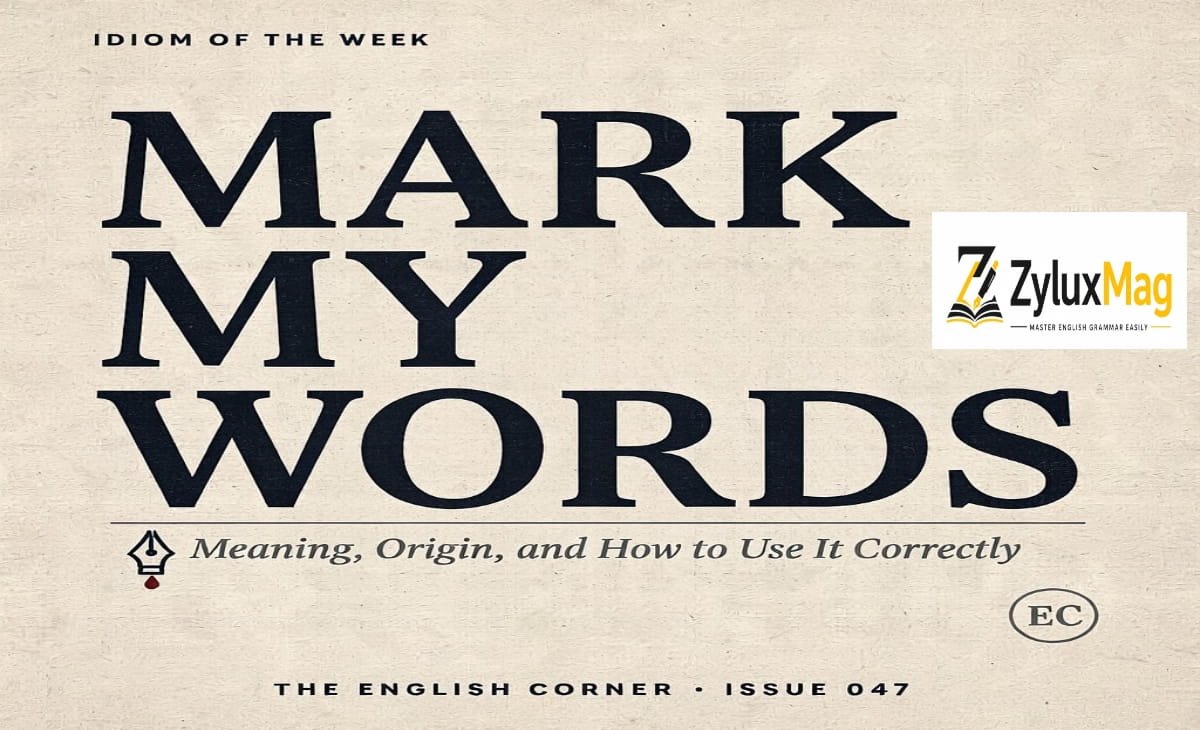
Mark my words is an idiom that means “pay close attention to what I’m saying, because it will turn out to be true.” People use it to introduce a confident prediction or warning about something that hasn’t happened yet — it’s not something you say about the past.
What Does “Mark” Mean in This Phrase?
The word “mark” here isn’t about writing, labeling, or grading anything. In this idiom, “mark” functions as a verb meaning “take notice of” or “pay close attention to.” So “mark my words” literally means “note carefully what I am about to say.”
Think of it as asking the listener to mentally highlight your statement — you’re telling them it matters enough to remember, because time is going to prove you right.
Where to Put “Mark My Words” in a Sentence
Correct: At the Start of the Statement
“Mark my words” almost always comes at the beginning of the sentence it’s emphasizing. It works like a signal that tells the listener, “Pay attention — here comes something important like later vs later on, usage depends on context.
- ✅ “Mark my words, that deal is going to fall through.”
- ✅ “Mark my words, she’ll be running this company in five years.”
Incorrect: In the Middle or at the End
Placing the phrase mid-sentence breaks up the statement it’s supposed to introduce and can sound clumsy.
- ❌ “That deal, mark my words, is going to fall through.”
It’s worth noting that ending a sentence with “mark my words” does happen in casual speech — “He’s going to regret this, mark my words” — and native speakers won’t consider it wrong. But leading with the phrase is the clearer, more natural default, especially in writing.
“Mark My Words” Is Always About the Future
This idiom only works before an outcome, never after one. It’s used to make a prediction or issue a warning, not to comment on something that has already happened.
- ✅ “Mark my words, he’ll be back within a week.” (prediction about the future)
- ❌ “Mark my words, he came back within a week.” (the event already happened — this doesn’t work)
If you’re talking about something that’s already occurred, “mark my words” isn’t the right phrase — see the comparison with “don’t say I didn’t warn you” below.
Early in my freelance writing days, I sent a client a line that read: “The deadline passed and, mark my words, we missed the launch.” My editor sent it back with one comment: “This already happened. You can’t ‘mark my words’ something that’s over.” I remember staring at the screen, embarrassed, because I genuinely thought the phrase just meant “seriously” or “trust me.” That one correction taught me more about this idiom than any dictionary definition could — it only works looking forward, never looking back.
“Mark My Word” vs. “Mark My Words” — Which Is Correct?
“Mark my words” (plural) is the standard modern form, and it’s what you’ll find in dictionaries and everyday use “Mark my word” (singular) does appear, especially in older or literary English, and it isn’t grammatically wrong — but it reads as slightly old-fashioned or regional today. If you’re unsure which to use, “mark my words” is the safer, more natural choice.
Examples of “Mark My Words” in Real Sentences
- “Mark my words, that boy is going to be a great writer one day.”
- “He’s going to regret this decision — mark my words.”
- “Mark my words, if you keep skipping practice, you’ll fall behind the rest of the team.”
- “Prices are going to keep climbing, mark my words.”
Notice that the phrase works equally well in a warning (“you’ll fall behind”), a prediction (“prices are going to keep climbing”), and a more dramatic, personal statement (“that boy is going to be a great writer”). The tone shifts, but the function stays the same: remember this, because I’m right.
Common Mistakes to Avoid
- Using it for the past. “Mark my words” only introduces something that hasn’t happened yet — never a done deal.
- Burying it mid-sentence. Lead with it whenever possible; it works best as an opening signal.
- Assuming “mark” means to write or label something. Here, it simply means “pay attention to” or “take note of.”
- Thinking “mark my word” (singular) is an error. It’s just older and less common — not incorrect.
Where Does “Mark My Words” Come From?
This phrase has been part of English for a very long time. One of its earliest recorded appearances is in Miles Coverdale’s 1535 English translation of the Bible, in Isaiah 28:23, where it’s used to call for careful attention. The idiom has stayed in everyday use ever since, showing up in speeches, literature, and casual conversation alike. It can sound a little formal or old-fashioned compared to more modern phrasing, but it’s still very much alive — you’ll see it in news quotes, everyday warnings, and confident predictions today.
“Mark My Words” vs. “Don’t Say I Didn’t Warn You”
These two phrases are often confused because they both involve warnings, but they’re used at opposite points in time.
| “Mark My Words” | “Don’t Say I Didn’t Warn You” | |
| Timing | Said before the outcome happens | Said after the outcome happens |
| Function | Introduces a prediction or warning | Reminds someone of a warning already given |
| Tone | Confident, forward-looking | Slightly accusatory, “I told you so” |
For example: you’d say “Mark my words, this plan won’t work” before the plan fails. But once it has failed, you’d say “Don’t say I didn’t warn you” — pointing back to the warning you already gave.