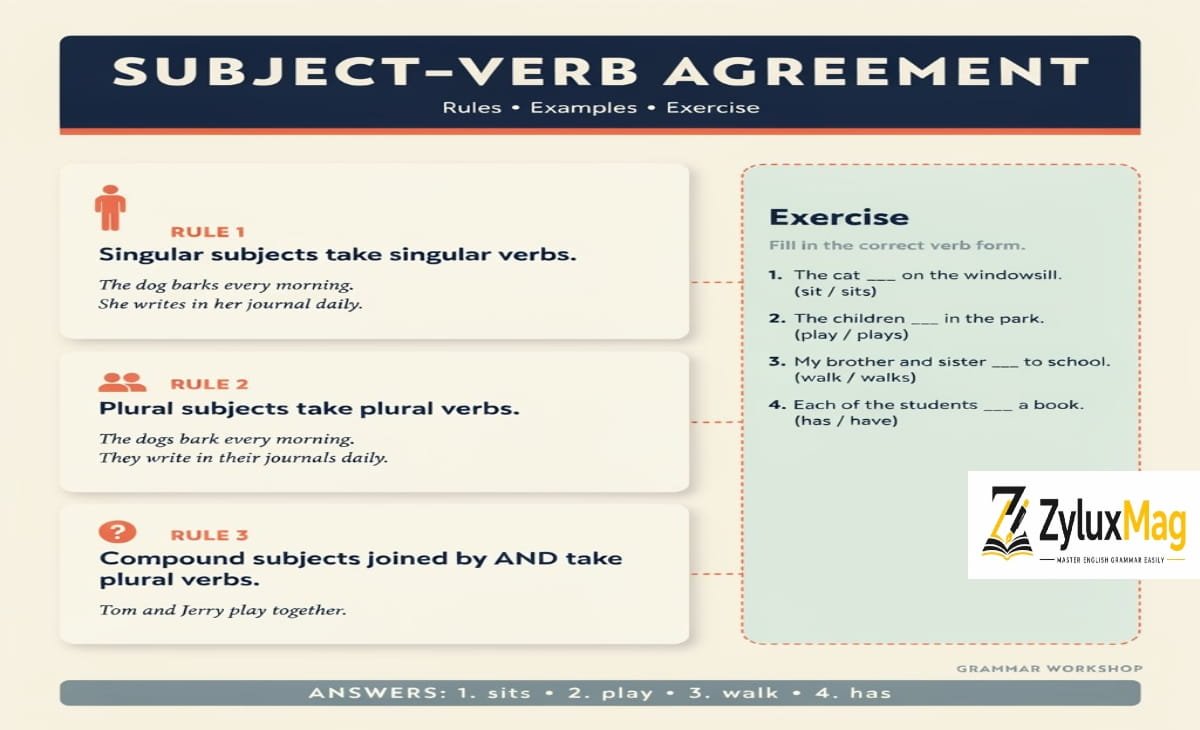
Subject-verb agreement means a singular subject takes a singular verb, and a plural subject takes a plural verb — no matter what words come between them.
Example: The list of items is long (not “are”), because the true subject is “list,” not “items.”
That one sentence covers the rule. The rest of this guide covers the situations where applying it isn’t as easy as it sounds.
Why This Trips People Up
I once sent my boss an email that said, “The results of the survey shows a clear trend.” One word. That’s all it took. She replied with just the sentence quoted back, no comment, and a tiny red circle around “shows.” I stared at my screen for a solid minute before it clicked — I’d matched the verb to “survey” because it was sitting right before it, not to “results,” the actual subject. I never made that mistake again. Now I mentally cross out everything between the subject and the verb before I hit send, and honestly, it’s saved me more than once.
That’s the trap almost everyone falls into eventually. Nobody gets agreement wrong on a simple sentence like “She walks” or “They walk.” The mistakes happen when the real subject gets hidden — buried under other words, placed after the verb, or disguised as something it isn’t.
The most common cause, by far, is this: writers match the verb to the nearest noun instead of the actual subject. In “the basket of apples is on the table,” some writers hear “apples” right before the verb and want to write “are.” But “apples” isn’t the subject — “basket” is.
Once you can reliably find the real subject, agreement becomes almost automatic. The sections below walk through every situation where finding it takes extra care.
Basic Agreement
Singular subject → singular verb. Plural subject → plural verb.
| Subject | Verb |
| The dog | barks |
| The dogs | bark |
| She | writes |
| They | write |
With pronouns, the same rule applies:
- Singular: I, he, she, it → He runs. It works.
- Plural: we, you, they → We run. They work.
- I is a special case: it uses am, not “is” — I am ready (not “I is ready”).
- You is always treated as plural in form, even for one person — You are late (never “you is”).
This part rarely causes real confusion. The tricky cases below are where most errors actually happen.
The Tricky Cases
1. Words Between the Subject and the Verb
Prepositional phrases and descriptive clauses often sit between the subject and its verb. They don’t change the verb — the original subject still decides it.
- ✅ The basket of apples is on the table.
- ❌ The basket of apples are on the table.
- ✅ The dog, who is chewing on my shoes, is usually well-behaved.
Rule: Cross out the phrase between the subject and the verb, and check agreement on what’s left.
2. Compound Subjects with “And”
Two subjects joined by “and” usually form a plural subject and take a plural verb.
- ✅ Tom and Priya are coming to the party.
Exception: When “and” joins two words that are treated as one idea or one thing, the verb stays singular.
- ✅ Bread and butter is my favorite breakfast.
- ✅ Slow and steady wins the race.
3. Subjects Joined by “Or,” “Nor,” “Either…Or,” “Neither…Nor”
When subjects are joined by these words, the verb agrees with the subject closest to it — not with all the subjects combined.
- ✅ Either the manager or the employees are responsible.
- ✅ Neither the teacher nor the students were ready.
- ✅ Neither the students nor the teacher was ready.
Rule: Find the subject right before the verb. That one decides the verb form.
4. Collective Nouns (team, family, committee, staff)
A collective noun refers to a group treated as one unit. In American English, these usually take a singular verb because the group is acting as one.
- ✅ (US) The committee is meeting today.
- ✅ (US) The team is playing well this season.
In British English, collective nouns can take a plural verb when the members are acting as individuals rather than as one unit.
- ✅ (UK) The committee are divided on the issue.
Neither version is “wrong” — the choice depends on which convention you’re following and whether the group is acting as a single unit or as separate individuals.
5. Indefinite Pronouns
Words like everyone, everybody, someone, anybody, nobody, each, either, neither are singular, even though they can refer to more than one person.
- ✅ Everyone is invited.
- ✅ Each of the students has submitted the assignment.
- ❌ Everyone are invited.
Words like both, few, many, several are plural.
- ✅ Both of them are ready.
Words like some, any, none, all, most can be either, depending on whether they refer to something countable or uncountable.
- ✅ Some of the cake is gone. (uncountable — singular)
- ✅ Some of the cookies are gone. (countable — plural)
6. Sentences Starting with “There” or “Here”
When a sentence begins with “there” or “here,” the real subject comes after the verb, not before it. Identify that subject before choosing the verb.
- ✅ There is a problem with the report.
- ✅ There are several problems with the report.
- ✅ Here is the file you asked for.
- ✅ Here are the files you asked for.
7. “Along With,” “As Well As,” “Together With”
These phrases are not the same as “and.” They don’t combine two subjects into a plural one — the original subject stays in charge of the verb.
- ✅ The manager, along with his team, is attending the meeting.
- ✅ The student, as well as her classmates, was praised for the project.
8. Amounts, Distances, and Time as a Single Unit
When an amount of money, distance, or time is treated as one quantity rather than as separate, countable items, it takes a singular verb.
- ✅ Ten dollars is too much for that.
- ✅ Five years is a long time to wait.
- ✅ Two miles is a reasonable distance to walk.
Related: “a number of” and “the number of” follow opposite rules.
- ✅ A number of students are absent today. (plural — focus is on the students)
- ✅ The number of students is increasing. (singular — focus is on the number itself)
Quick Reference
| Pattern | Rule | Example |
| Phrase between subject and verb | Ignore the phrase; match the real subject | The basket of apples is ripe. |
| Subjects joined by “and” | Usually plural | Tom and Priya are here. |
| Fixed “and” expressions | Singular | Bread and butter is tasty. |
| Or / nor / either…or / neither…nor | Verb agrees with the nearer subject | Neither he nor they were late. |
| Collective nouns | Singular (US) or plural (UK) depending on unity | The team is/are playing. |
| Indefinite pronouns: everyone, each, nobody | Singular | Everyone is here. |
| Indefinite pronouns: both, few, many | Plural | Both are ready. |
| Some / any / none / all / most | Depends on countable vs. uncountable | Some of the cake is gone. |
| Sentences starting with “there/here” | Find the subject after the verb | There are two options. |
| Along with / as well as / together with | Doesn’t change the original subject | He, along with his team, is here. |
| Amounts, distance, time as one unit | Singular | Ten dollars is enough. |
| A number of / the number of | Plural / singular respectively | A number of people are waiting. |
Common Mistakes to Watch For
- Matching the verb to the nearest noun instead of the real subject. This is the single most frequent error — always trace the sentence back to its true subject.
- Assuming “and” always creates a plural subject. Fixed expressions like “bread and butter” or “slow and steady” are exceptions.
- Treating “along with,” “as well as,” and “together with” as conjunctions like “and.” They aren’t — the original subject still controls the verb.
- Getting the verb order wrong in “there/here” sentences. Locate the subject first, even though it comes after the verb.
- Assuming collective nouns are always singular. This is true in American English but not always in British English.
- Confusing “a number of” with “the number of.” They take opposite verb forms.
Quick Self-Check
Choose the correct verb for each sentence.
- The list of items (is / are) very long.
- Neither the players nor the coach (was / were) happy with the result.
- Bread and butter (is / are) all I need for breakfast.
- Everyone in the room (was / were) silent.
- There (is / are) three reasons for this decision.
- The number of applicants (has / have) doubled this year.
- The committee (is / are) meeting to finalize the budget. (American English)
Answers: 1. is 2. was 3. is 4. was 5. are 6. has 7. is
About the Author
Admin writes and edits grammar and vocabulary guides for ZyluxMag, focusing on the rules that trip up real writers in real emails, essays, and everyday conversations — not just textbook examples.