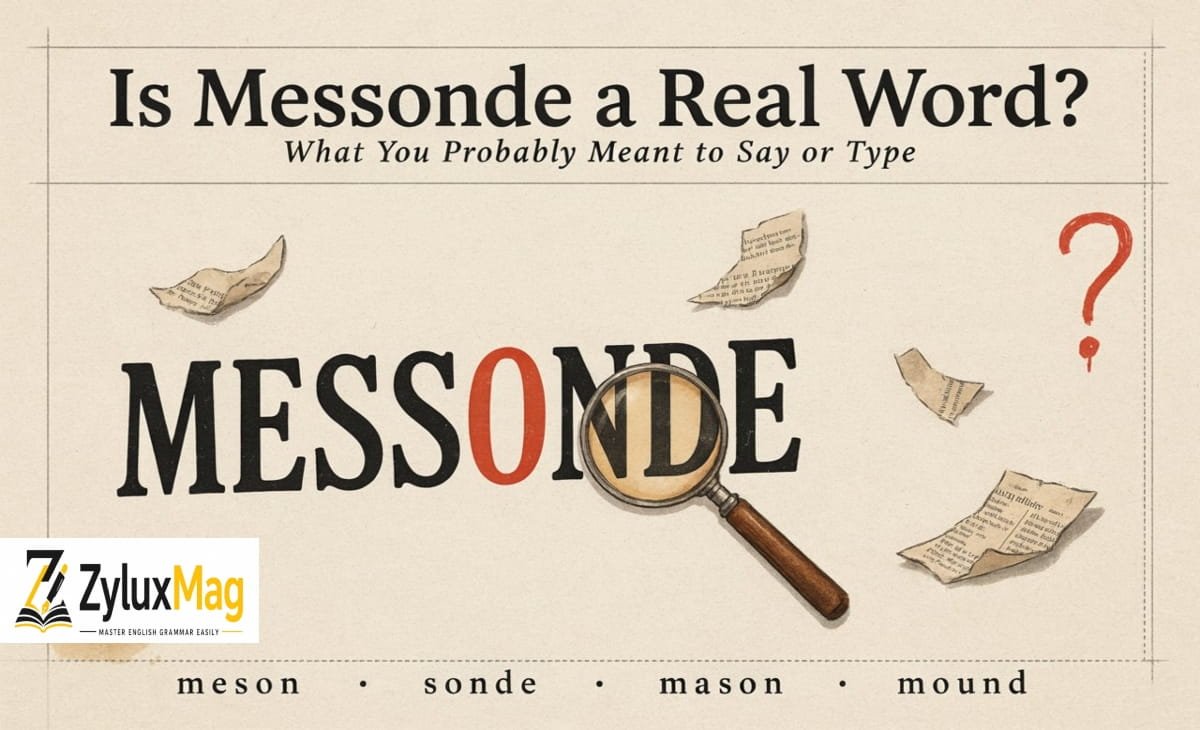
Short answer: No — “messonde” is not a recognized English word. It doesn’t appear in Merriam-Webster, Oxford, or standard etymology references, and it has no established grammar rule, spelling, or usage attached to it. If you came across it somewhere or typed it from memory, you almost certainly meant one of a small number of real words that sound or look similar — most likely the French word mensonge.
Here’s how to figure out which one you actually need.
Why “Messonde” Doesn’t Appear in Any Dictionary
Checking major English dictionaries, etymology databases, and word-validity lists (including sources used by Scrabble and spelling-reference tools) turns up nothing for “messonde.” That’s a strong signal it isn’t a standard word in English — it hasn’t been adopted, recorded, or defined anywhere.
This usually means one of three things happened:
- You heard a foreign word spoken aloud and spelled it the way it sounded in English.
- Autocorrect or a typo merged two words or dropped/added a letter.
- You saw a proper noun (a name, brand, or username) and mistook it for a common word.
None of these are unusual. Language mix-ups like this happen constantly, especially with foreign words that don’t map cleanly onto English spelling patterns.
What You Might Have Actually Meant
Mensonge (French — “a lie”)
This is the closest match, both in sound and spelling. Mensonge is a French noun meaning “a lie” or “a falsehood.”
- Pronunciation: mahn-SOHNZH
- Example: “Dire un mensonge” means “to tell a lie.”
If you heard this word in conversation, a song, or a French lesson and tried to spell it by ear, “messonde” is a very plausible English approximation — the nasal French vowels and the soft “g” sound don’t have an obvious English spelling equivalent, so this kind of phonetic guess is common.
I still remember sitting in my first French class, hearing the professor say “mensonge” during a lesson on honesty and lying. I scribbled it down phonetically in my notebook — something close to “messonde” — and used it confidently in a homework sentence. She handed it back with a red circle and a raised eyebrow. That was the moment I realized hearing a word and knowing how to spell it are two completely different skills, especially across languages. I’ve double-checked unfamiliar words before writing them down ever since.
Mesne (English — legal term meaning “intermediate”)
Mesne is a genuine but rare English word, used almost exclusively in legal and historical contexts. It refers to something that is intermediate — in between two other things — most often describing a position in a chain of authority how to check if a word actually exists.
- Pronunciation: MEEN (it rhymes with “mean”)
- Example: “A mesne lord held land from a higher lord but also had his own tenants beneath him.”
This word is easy to mistake for an invented one precisely because it’s so uncommon — most native English speakers never encounter it outside of law or medieval history.
Messed (English — past tense of “mess”)
- Pronunciation: MEST
- Example: “I messed up the schedule.”
This is included only because “mess-” is the recognizable fragment inside “messonde.” If your intended word was simpler than a legal term or a French borrowing, this may be it — though it’s the least likely match overall.
Quick Comparison
| Candidate word | Language | Meaning | Pronunciation | How likely it’s the one you meant |
| Mensonge | French | A lie, a falsehood | mahn-SOHNZH | High |
| Mesne | English (legal) | Intermediate, in-between | MEEN | Medium |
| Messed | English | Past tense of “mess” | MEST | Low |
If none of these match what you had in mind, it’s also worth considering that “Messonde” could simply be a name — a surname, brand, or username — rather than a word with a dictionary meaning at all.
How Words Like This Get Invented
Nonsense or “almost-real” words usually come from one of these patterns:
- Cross-language spelling by ear. When a word from another language is heard rather than read, the listener naturally spells it using their own language’s rules — which don’t always exist for those sounds. This is the most likely explanation here, given how close “messonde” sits to mensonge.
- Autocorrect drift. Phone keyboards sometimes “correct” a typo into a different but equally wrong string of letters, especially with uncommon words.
- Blending two real words. Two similar-looking words get merged in memory, producing something that looks plausible but doesn’t exist.
None of this means you did anything wrong by searching for it — it’s one of the more common ways people end up trying to verify a word that turns out not to exist in the form they typed.
About the Author
Admin writes and edits grammar and vocabulary content for ZyluxMag, breaking down confusing words, spelling mix-ups, and everyday English questions into clear, practical explanations for learners at every level.