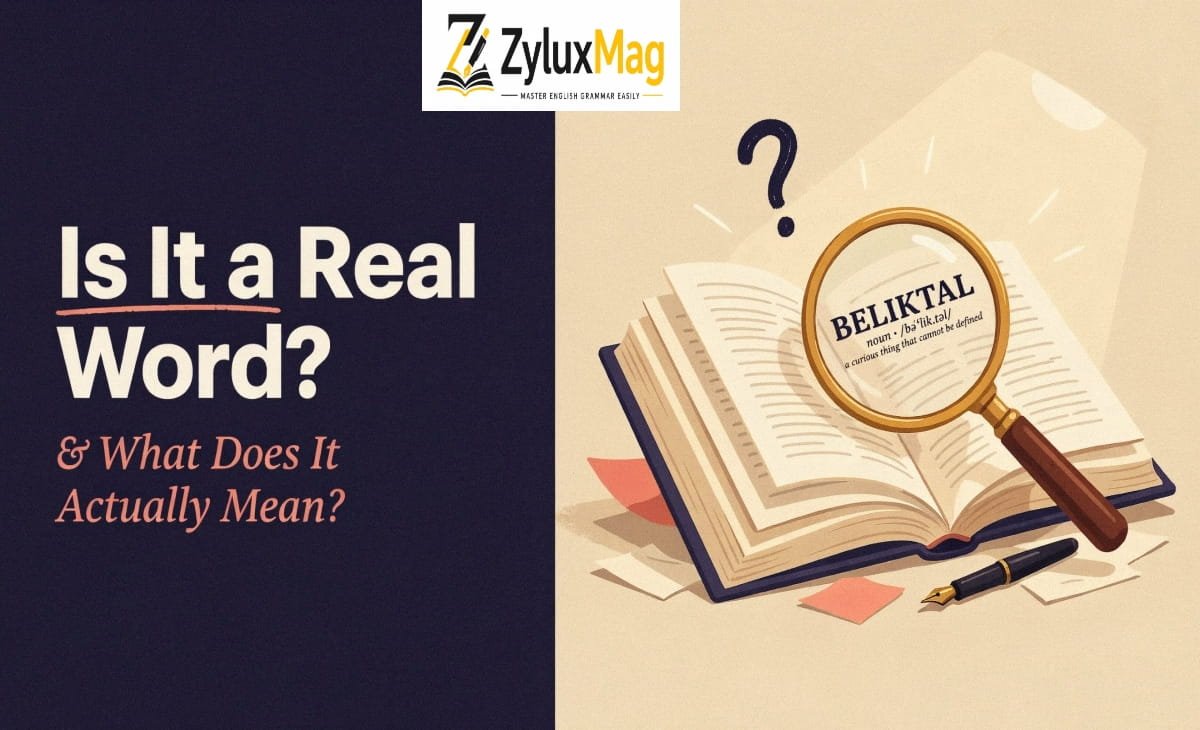
Short answer: “Beliktal” is not a standard English word, and no reliable source gives it an established meaning. Online, it is described as a place, a lifestyle idea, a sports system, and a brand name. These descriptions contradict each other, and none is backed by evidence you can check. It is best treated as an internet-circulated coinage with no fixed definition.
What people online say beliktal means
If you search for the word, you will find confident explanations. The problem is that they don’t agree.
| Claimed meaning | How it is described | Can it be verified? |
| A peaceful place | A quiet area surrounded by nature, described as remote and hidden; some sites name a specific country, but none gives verifiable evidence | Another source notes there is no confirmed evidence it is an officially recognized location |
| A lifestyle | A calm, simple way of living | No source of record; it is a description, not a definition |
| A sports system | A precision passing approach in team sports | We found no independent source supporting this |
| A brand or digital identity | A brandable term, unusual enough to be memorable | Only as a made-up name, not as a word with meaning |
| A heritage site | A location linked to ancient settlement and migration | We found no archaeological source supporting this |
| An abstract concept | A flexible idea whose meaning depends on context | Not a definition; it says the word can mean anything |
A hidden valley, a passing system in team sports, and an ancient settlement cannot all be what the word means. When one word has several unrelated meanings and none of them is documented outside pages that discuss the word itself, the likeliest explanation is that nobody has established a meaning at all.
Why one unknown word gets explained so many ways
Search behavior explains most of it. People see an unfamiliar word and search for it. Websites notice the searches and publish explanations. Those explanations often borrow from each other or fill the gaps with guesses, which brings more attention and more searches. One page describes this cycle directly: as more content appears around such a term, it gains visibility even without a real-world reference.
The carelessness is sometimes visible is this a real word or not? Some of the pages drift into other words entirely. One discusses “kerkt” and the Dutch word for “church” under a beliktal heading, and another switches to the spelling “Belikital” halfway through. If you have searched for one of those spellings, the same answer applies: no verified meaning has been found for it either.
Does the “Pure Valley” origin hold up?
One explanation comes up repeatedly. It says “beli” might come from a Slavic word meaning “white” or “pure,” and “tal” from a Germanic word for “valley,” giving “Pure Valley” or “White Valley.”
That sounds tidy, but it is a guess, and it has problems:
- The pieces are matched to the word after the fact. Any unfamiliar word can be split into fragments that resemble words in other languages.
- The “k” is unexplained. The theory has no account of the letter in the middle.
- No one documents it. The articles that repeat the theory give no sources, such as a dictionary, an early text, or a language scholar.
Tidy origin stories are often false. Many people believe posh came from “port out, starboard home,” and that golf stands for “gentlemen only, ladies forbidden.” Neither story has good evidence behind it, and both are standard examples of folk etymology, the habit of inventing a clever origin for a word whose real history is unknown or plainer. A neat explanation is not proof.
How to check whether any word is real
When I started researching this word, I expected a clear definition within a few minutes. Instead I found more than a dozen pages, each explaining it differently, and almost none pointed to a source. Several seemed to be copying one another, and one even wandered off into a completely different word. I was tempted to pick the most confident-sounding explanation, just so I could hand readers a neat answer. Then I realized that would make me the next site repeating a guess.
That experience is why I now use the same short method on any unfamiliar word:
- Look it up in major dictionaries. Try Merriam-Webster, the Oxford English Dictionary, Collins, and Cambridge. A missing entry doesn’t always mean a word is wrong, since very new or specialist words may not be listed yet, but it tells you the word is not established.
- Look for independent, dated use. Books, newspapers, academic papers, and official websites count. Blogs that copy each other do not, because they can all trace back to one guess.
- Look for a documented origin. A real word usually has a traceable history, even if the history is uncertain.
- See whether sources agree. Reliable sources may differ on details, but they should agree on the basic meaning.
Here is how beliktal fares, based on our searches as of September 21, 2026:
| Check | Result |
| Dictionary entry | None found in our search of reference sites. Check Merriam-Webster, the OED, Collins, and Cambridge directly for the latest position. |
| Independent sources | The results were mostly blog and magazine-style pages. None was a reference work, news report, or academic source. |
| Documented origin | None found. The “Pure Valley” idea appears without a source. |
| Agreement on meaning | No. See the table above. |
| Overall | Not an established word |
Real word, coinage, or brand name?
Unfamiliar words fall into different categories, and mixing them up causes much of the confusion around terms like this one.
| Type | What it means | Example | Beliktal? |
| Dictionary word | Established in use and recorded by dictionaries | table, selfie | No |
| Coinage | A word deliberately invented by a person | chortle, created by Lewis Carroll and now standard | Possibly, but the inventor is unknown |
| Nonce word | A word made up for a single occasion and not meant to last | slithy in Carroll’s “Jabberwocky” | Possible |
| Brand name | An invented or chosen name for a product or organization | Kodak | Some sites use it this way |
| Typo or variant | A misspelling or altered form of another word | recieve for receive | Unlikely, but variants like “Belikital” exist |
A coinage can become a real word, and chortle is proof. So can a new word from popular culture: selfie was named Oxford Dictionaries’ Word of the Year in 2013 and now appears in major dictionaries. What makes the difference is time and use. Lexicographers generally look for evidence that a word is used by many different writers, in independent sources, over a period of time. Being searched for a lot is not the same thing.
Beliktal has not reached that stage. At best, it is a new coinage with no shared meaning.
Can you use “beliktal” in your writing?
You can, as long as you are clear about what you mean by it. Three practical points:
- Define it or treat it as a name. Readers can’t infer a meaning that doesn’t exist. If you use it as a brand, blog, or character name, say so.
- Capitalize it as a name. For a brand or place in a story, write Beliktal. When you discuss the word itself, lowercase italics are fine: the word beliktal.
- Avoid using it as a common noun. Writing “a beliktal” treats it as an ordinary countable noun, but it has no established grammatical status. Use it as a name instead.
Compare these sentences:
- Safe: “Some websites use beliktal as a brand name, but no standard dictionary defines it.”
- Risky: “Beliktal is a valley in the western United States famous for its hot springs.”
The second states an unverified place, location, and feature as fact. If a reader believed it and made travel plans, you would have misled them.
What would change this answer
This page reflects what could be found on September 21, 2026. The answer would change if:
- a major dictionary added an entry
- a mapping or government source confirmed a place with this name
- independent books, news reports, or academic sources began using it consistently with one meaning
Until then, the honest answer stays the same: beliktal is a word people are curious about, but it has no established meaning.
About the author
Faizan Babar is the owner and main writer of ZyluxMag, where he writes practical guides on English grammar and vocabulary. His articles aim to give learners clear, checked answers instead of repeating whatever ranks first online.