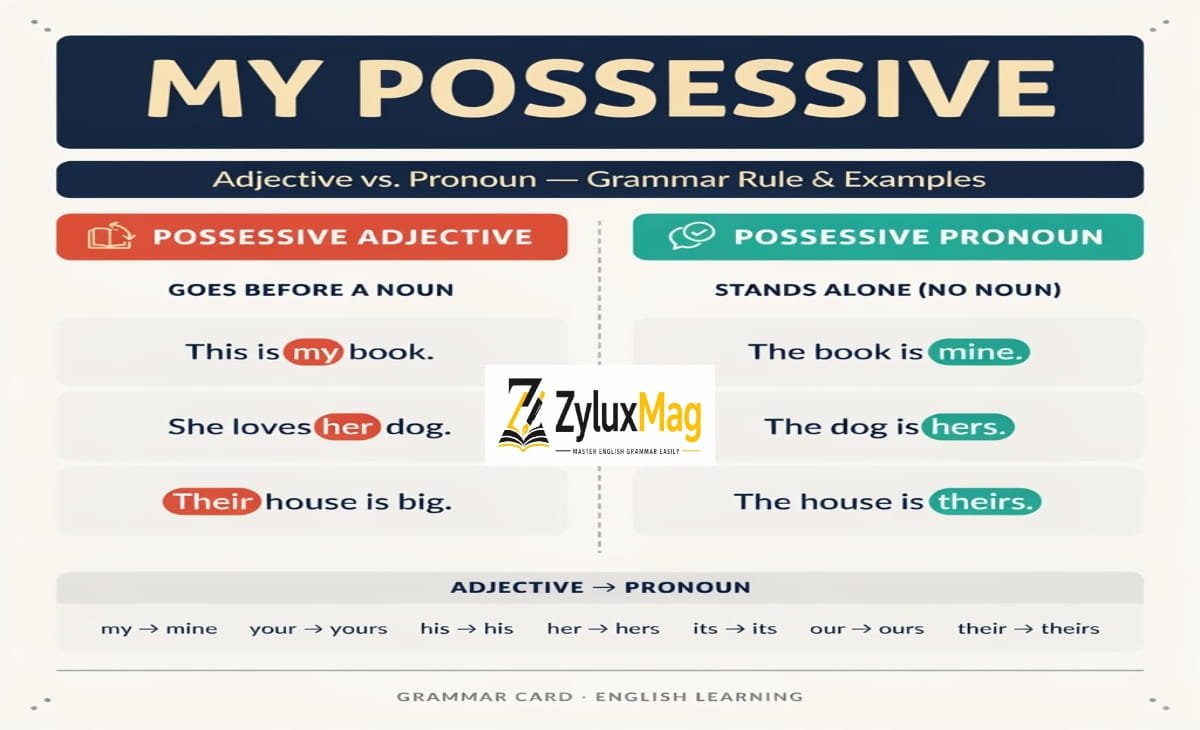
My is a possessive adjective (also called a possessive determiner). It shows that something belongs to the speaker, and it always comes directly before a noun — as in my phone or my idea. It’s different from “mine,” which is a possessive pronoun used alone, without a noun after it.
That one distinction — adjective vs. pronoun — is where most confusion about “my” starts. Here’s the full picture.
A Mistake That Taught Me This the Hard Way
Years ago, early in my freelancing days, I sent a client a message that read: “The invoice attached is my.” I hit send, felt proud of myself for being quick, and moved on with my day. Ten minutes later she replied with a single line: “Is it yours, or mine?” I stared at my screen, mortified, and reread the sentence about four times before it clicked. That tiny missing word cost me a chunk of my professional credibility that morning — and taught me, permanently, that “my” can never survive alone at the end of a sentence.
What Part of Speech Is “My”?
“My” is a possessive adjective. Some modern grammar resources call it a possessive determiner instead — both terms describe the same word and the same job, so you’ll see either one depending on the source.
Its job is simple: it goes before a noun to show that the noun belongs to the speaker (the first-person “I”).
- my keys
- my opinion
- my sister’s house (still “my,” even before a possessive noun)
A common misconception is that “my” is a pronoun, since it clearly relates to “I.” But a pronoun replaces a noun, while “my” modifies one — it never stands in for the noun itself. That’s the real test: if the word is sitting right in front of a noun, it’s doing an adjective’s job, not a pronoun’s.
“My” vs. “Mine”: The One Rule You Need
This is the single most searched confusion around this word, and it comes down to one question:
Is there a noun right after it?
| Is there a noun after the word? | Use |
| Yes | my — my car |
| No | mine — This car is mine. |
“My” always needs a noun to attach to. “Mine” never takes one — it stands completely on its own, usually at the end of a sentence or clause.
- ✅ My car is parked outside.
- ✅ That car is mine.
- ❌ That car is my.
- ❌ Mine car is parked outside.
If you can mentally swap the word out and a noun is still sitting next to it, “my” is correct. If the word is standing alone, doing the noun’s job by itself, “mine” is correct.
You’ll sometimes see “mine” paired with an article in phrases like “a friend of mine” — this isn’t an exception to that rule, since “mine” (not “my”) is the word used there, and it’s standing alone after “of,” exactly as the rule predicts.
How to Use “My” Correctly in a Sentence
Rule 1 — “My” Always Comes Before a Noun
“My” can’t function on its own. It needs a noun (or noun phrase) immediately after it to complete its meaning.
- my laptop
- my best friend
- my train ticket
Rule 2 — “My” Doesn’t Change for Plural Nouns
Unlike words such as “this/these” or “that/those,” “my” stays exactly the same whether the noun after it is singular or plural.
- my shoe → my shoes
- my idea → my ideas
There’s no separate plural form of “my” to learn — that’s one less rule to worry about subject–verb agreement rules.
Rule 3 — Never Pair “My” with “The” or “A”
In English, possessive adjectives and articles (“the,” “a,” “an”) can’t sit together in front of the same noun. You use one or the other, never both.
- ✅ my book
- ❌ the my book
- ❌ a my book
If you want to add extra detail, place it after “my,” not before: my favorite book, not the my favorite book.
Common Mistakes with “My” (and How to Fix Them)
Mistake 1: Using “my” where “mine” belongs’
❌ This seat is my.
✅ This seat is mine.
If nothing follows the word, you need “mine,” not “my.”
Mistake 2: Treating “my” as a pronoun
“My” can’t replace a noun by itself. It always needs one attached — my by itself, with nothing after it, is incomplete.
Mistake 3: Stacking “my” with an article
❌ I lost the my wallet.
✅ I lost my wallet.
Mistake 4: Confusing “my” with “I’m” in fast typing
These are unrelated words that just happen to look similar when typed quickly — “my” shows possession, “I’m” is short for “I am.” Autocorrect and typing speed are usually the culprits here, not a grammar misunderstanding.
Quick Answers
Is “my” singular or plural?
“My” itself has no singular or plural form — it stays the same regardless of the noun that follows (my dog, my dogs). Only the noun changes.
Is “my” ever capitalized in the middle of a sentence?
No. Like other possessive adjectives, “my” is only capitalized at the start of a sentence or in a title, never mid-sentence just because it refers to the speaker.
How does “myself” relate to “my”?
“Myself” is a reflexive pronoun built from “my” + “self.” It’s used when the subject and object of a sentence are the same person — I taught myself — and it’s a separate word with its own rules, not a form of “my.”
Can “my” ever stand alone?
No. If you don’t have a noun to put after it, you need “mine” instead.
About the Author
Admin writes and edits grammar guides for ZyluxMag, breaking down English rules into clear, practical lessons for learners and writers alike. When not untangling grammar mix-ups, Admin is usually double-checking a sentence before hitting send.