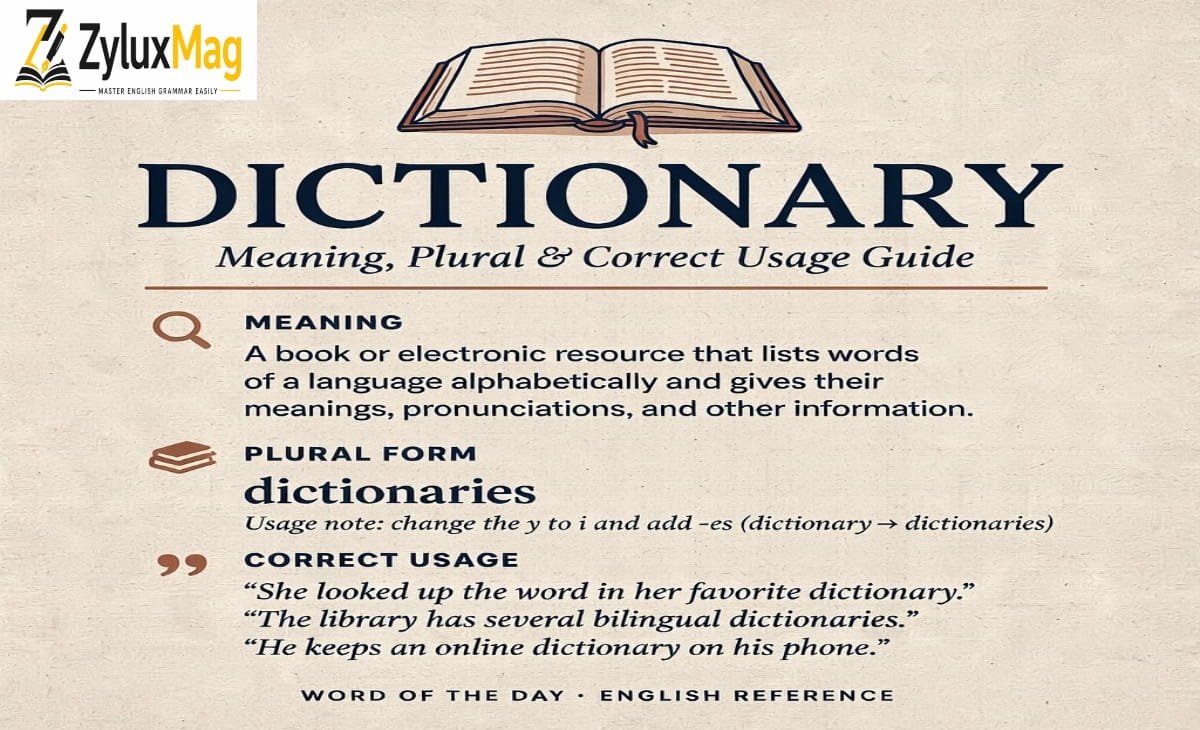
A dictionary is a reference book or resource that lists words alphabetically along with their meanings, pronunciations, and parts of speech. Its plural is dictionaries, not “dictionarys.”
What “Dictionary” Means
A dictionary is a tool for understanding a language. Each entry typically tells you:
- the word’s meaning (or meanings, if it has more than one)
- how to pronounce it
- its part of speech (noun, verb, adjective, and so on)
- sometimes its origin (etymology) and example sentences
Dictionaries can be printed books or digital tools — the format has changed, but the purpose hasn’t. Whether you’re using a physical Oxford dictionary or an app on your phone, you’re doing the same thing: looking up a word to confirm or discover what it means.
One thing worth clearing up: a dictionary doesn’t invent correct spelling or meaning. It records how people actually use words. When usage changes over time, dictionaries update to reflect that — they follow the language, they don’t dictate it correct spelling rules in English.
Is “Dictionary” Countable? Using “A,” “The,” and “Dictionaries” Correctly
Yes — “dictionary” is a countable noun. That means it can take “a” or “an,” it has a plural form, and you can count it: one dictionary, two dictionaries, three dictionaries.
Singular vs. Plural in a Sentence
Use “a dictionary” when you mean any dictionary, not a specific one:
- She bought a dictionary for her English class.
Use “the dictionary” when you mean a specific one — one you’ve already mentioned, or one that’s obvious from context (like the one sitting on a desk):
- The teacher checked the dictionary on her desk.
Use the plural, “dictionaries,” when talking about more than one:
- Modern classrooms often have several dictionaries on the shelf.
Don’t drop the article altogether. In English, countable singular nouns almost always need “a,” “an,” or “the”:
- ❌ I checked dictionary.
- ✅ I checked the dictionary.
The Plural of “Dictionary” — Why It’s “Dictionaries,” Not “Dictionarys”
This is the most common spelling mistake with this word, so it’s worth explaining the rule rather than just stating it.
I once sent a client a message listing “three dictionarys I’d recommend for the project” — and didn’t notice until she replied, gently, with the correct spelling quoted right back at me. My stomach dropped. I’d been writing professionally for two years and still tripped on a rule I’d learned in fourth grade. That night I sat down and actually looked up why it changes to “ies,” instead of just memorizing it again. Turns out understanding the rule stuck way better than just fixing the typo ever did. Now I catch myself checking every “-y” word before hitting send, just in case.
The Spelling Rule (Consonant + Y → -ies)
When a noun ends in a consonant + y, you form the plural by changing the y to i and adding -es.
“Dictionary” ends in r + y (a consonant followed by y), so it follows this pattern:
dictionary → dictionaries
This isn’t a one-off exception — it’s a regular rule that applies to many similar words:
| Singular | Plural |
| dictionary | dictionaries |
| story | stories |
| country | countries |
| category | categories |
Compare this with nouns ending in a vowel + y, which just add -s with no spelling change: toy → toys, day → days. The rule only kicks in when a consonant comes right before the y.
Dictionary vs. Thesaurus vs. Glossary vs. Lexicon
These four words get mixed up often because they’re all “word reference” tools — but they do different jobs.
| Term | What It Does |
| Dictionary | Defines words: meaning, pronunciation, part of speech |
| Thesaurus | Lists synonyms and antonyms for a word |
| Glossary | Defines specialized terms used within one subject or book |
| Lexicon | Refers to the entire vocabulary of a language or field (a broader, more academic term) |
A simple way to remember the two most-confused ones: a dictionary tells you what a word means; a thesaurus tells you other words that mean something similar. If you want to know what “meticulous” means, use a dictionary. If you want a fancier word for “careful,” use a thesaurus.
Common Mistakes with “Dictionary”
- Misspelling the plural — writing “dictionarys” instead of “dictionaries.”
- Confusing dictionary and thesaurus — a dictionary defines; a thesaurus offers alternatives.
- Dropping the article — saying “I looked in dictionary” instead of “I looked in the dictionary” or “I looked in a dictionary.”
- Assuming dictionaries set the rules — they describe how language is used, not the other way around.
What Does “Dictionary Form” Mean?
You’ll often see this phrase in grammar instruction: “Give the dictionary form of the verb.”
The dictionary form (also called the base form or citation form) is the version of a word you’d actually find as its own entry in a dictionary — not the version that shows up in a sentence.
For example:
- The dictionary form of “ran” is run.
- The dictionary form of “better” (as in “she is better now”) is good.
- The dictionary form of “swimming” is swim.
This matters because dictionaries don’t list every conjugated or inflected form of a word separately. If you look up “ran,” a good dictionary will point you to “run” — that’s where the actual definition lives.
About the Author
Admin writes about English grammar and vocabulary at ZyluxMag, focusing on the small usage details — spelling, word choice, and everyday mistakes — that make writing clearer and more confident.