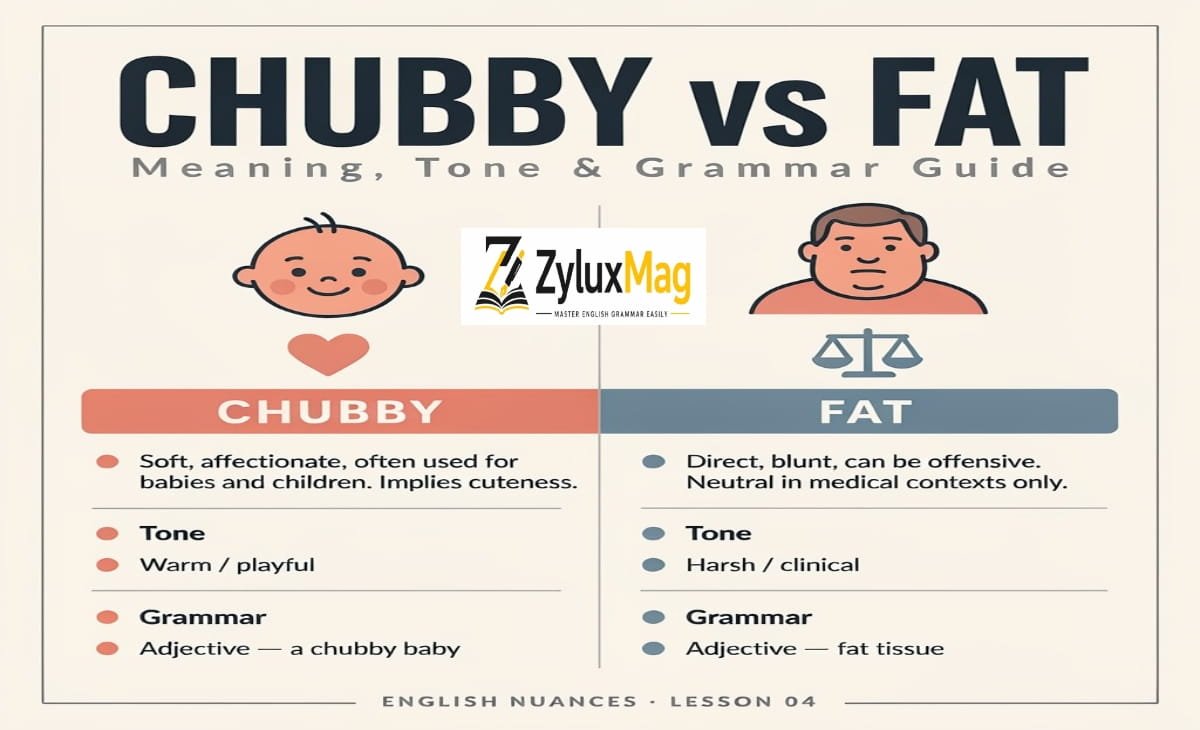
Chubby vs Fat describes someone slightly overweight and is usually said gently or affectionately. “Fat” describes someone clearly overweight and is more blunt and direct. The two words differ mainly in degree and tone, not in strict definition — and understanding that difference is the key to using either word correctly.
Last year, my aunt sent a photo of my baby cousin in the family group chat, and I replied, “He’s getting so fat, it’s adorable!” I meant it as a compliment, the way you’d coo over a plump little baby. My aunt didn’t reply for a full day. When she finally did, she just said, “He’s chubby, not fat.” I felt awful. That one word swap taught me more about tone than any grammar book ever did — “chubby” would’ve landed exactly the warmth I meant, and “fat” just sounded like an insult I never intended.
Chubby vs. Fat at a Glance
| Word | Degree of Weight | Tone | Typical Use | Example |
| Chubby | Slightly overweight | Soft, affectionate | Babies, children, casual/friendly speech | “The baby has chubby cheeks.” |
| Fat | Noticeably overweight | Blunt, direct (neutral in science) | Everyday speech; also clinical/biological contexts | “The report measures body fat percentage.” |
What “Chubby” Means
Chubby is an adjective that means slightly overweight, with a soft or rounded appearance. It’s a mild word, and it’s often used in a warm or even complimentary way — especially for babies, children, or animals.
How to use it in a sentence:
- “The puppy had chubby little paws.”
- “She has chubby cheeks.”
- “He’s gotten a bit chubby since he stopped playing soccer.”
Notice that “chubby” works comfortably with things people find cute (babies, cheeks, puppies). This is part of why it feels gentler than “fat.”
What “Fat” Means
Fat is also an adjective, but it can function as a noun too. As an adjective, it describes someone or something with a noticeable amount of extra weight. As a noun, “fat” refers to the substance itself — the oily tissue stored in the body (“body fat,” “fat cells”).
How to use it in a sentence:
- “The cat grew fat after months of overeating.” (adjective)
- “The doctor explained how the body stores fat.” (noun)
- “That was the fattest dog at the shelter.” (superlative adjective)
Because “fat” is more direct, it tends to carry more emotional weight in everyday conversation than “chubby” does.
The Real Difference: Degree and Tone
The gap between these two words isn’t really about grammar — it’s about how much and how it sounds.
- Degree: “Chubby” suggests a small, often endearing amount of extra weight. “Fat” suggests a larger, more noticeable amount.
- Tone: “Chubby” softens the description. “Fat” states it plainly, with no cushioning.
This is why the same person could be called “a little chubby” by a friend and “fat” by a stranger — the facts might be similar, but the word choice changes how it lands.
One important exception: in science and medicine, “fat” is neutral understanding comparative forms in English Terms like body fat percentage, fat cells, and dietary fat describe biology, not judgment. It’s only in casual, person-to-person speech that “fat” tends to feel harsh.
Comparative and Superlative Forms
Both words follow regular adjective patterns — but the spelling changes are different, and this is where learners often make mistakes.
Fat → fatter → fattest Because “fat” ends in a single vowel + single consonant, the final consonant is doubled before adding -er or -est.
- ✅ fatter, fattest
- ❌ fater, fatest
Chubby → chubbier → chubbiest Because “chubby” ends in a consonant + -y, the y changes to i before adding -er or -est.
- ✅ chubbier, chubbiest
- ❌ chubbyer, chubbyest
Example sentences:
- “He is chubbier than his brother.”
- “That was the fattest cat I’ve ever seen.”
Is It Rude to Call Someone Chubby or Fat?
It depends on the person, the relationship, and the context — but there are some reliable patterns.
Chubby:
- Calling a baby or young child “chubby” is almost always seen as harmless, even sweet.
- Calling an adult “chubby” is milder than calling them “fat,” but it can still feel unwelcome or slightly patronizing, especially from someone who isn’t close to that person.
Fat:
- In casual conversation about a person, “fat” is usually considered blunt and can come across as insulting, even if that’s not the intent.
- In scientific, medical, or nutritional writing, “fat” is standard and carries no judgment at all.
The safest rule: unless you’re speaking clinically or the person has invited the comment, it’s generally better to avoid commenting on an adult’s weight with either word.
More Polite Alternatives to Use Instead
If you want to describe someone’s weight without sounding blunt or risking offense, these words are commonly used as softer alternatives:
- Plump — similar to chubby, often used for a rounded, soft appearance
- Curvy — usually describes a shapely figure, often used positively
- Heavyset — describes a solidly built, larger frame, fairly neutral in tone
- Overweight — a more clinical, factual term, common in health contexts
Each of these carries its own shade of meaning, so context still matters — but they generally sound gentler than “fat” in everyday speech.
Common Mistakes to Avoid
- Treating “chubby” and “fat” as exact synonyms. They both relate to extra weight, but they differ in degree and tone — swapping one for the other can change how a sentence sounds.
- Assuming “chubby” is always polite. It’s softer than “fat,” but it can still bother an adult who doesn’t want their weight mentioned at all.
- Assuming “fat” is always negative. In biology and nutrition, it’s a neutral, factual term.
- Misspelling the comparative/superlative forms — remember: double the consonant for fat (fatter, fattest), and change y to i for chubby (chubbier, chubbiest).
- Confusing “chubby” with “plump,” “pudgy,” or “curvy” as if they mean exactly the same thing. They’re related, but each has its own nuance worth knowing.
Quick Answers
Is “chubby” the same as “fat”?
No. “Chubby” means slightly overweight and sounds gentle. “Fat” means noticeably overweight and sounds more direct.
Can you call a baby chubby?
Yes — “chubby” is commonly and positively used to describe babies and young children.
Is “fat” ever a neutral word?
Yes, in scientific and medical contexts (like “body fat” or “fat cells”), it’s a standard, judgment-free term.
What’s the plural or comparative of “chubby”?
“Chubby” doesn’t have a plural form since it’s an adjective, not a noun. Its comparative and superlative forms are chubbier and chubbiest.
What’s a more polite word than “fat”?
“Overweight,” “heavyset,” “curvy,” and “plump” are commonly used as gentler alternatives, depending on context.
About the Author
Faizan Babar is the founder and lead writer at ZyluxMag, where he breaks down English grammar and vocabulary into simple, practical lessons for everyday learners. Drawing on years of hands-on writing experience — including plenty of real-world word mix-ups along the way — he focuses on the kind of language guidance that actually helps people communicate better, not just pass a grammar test.