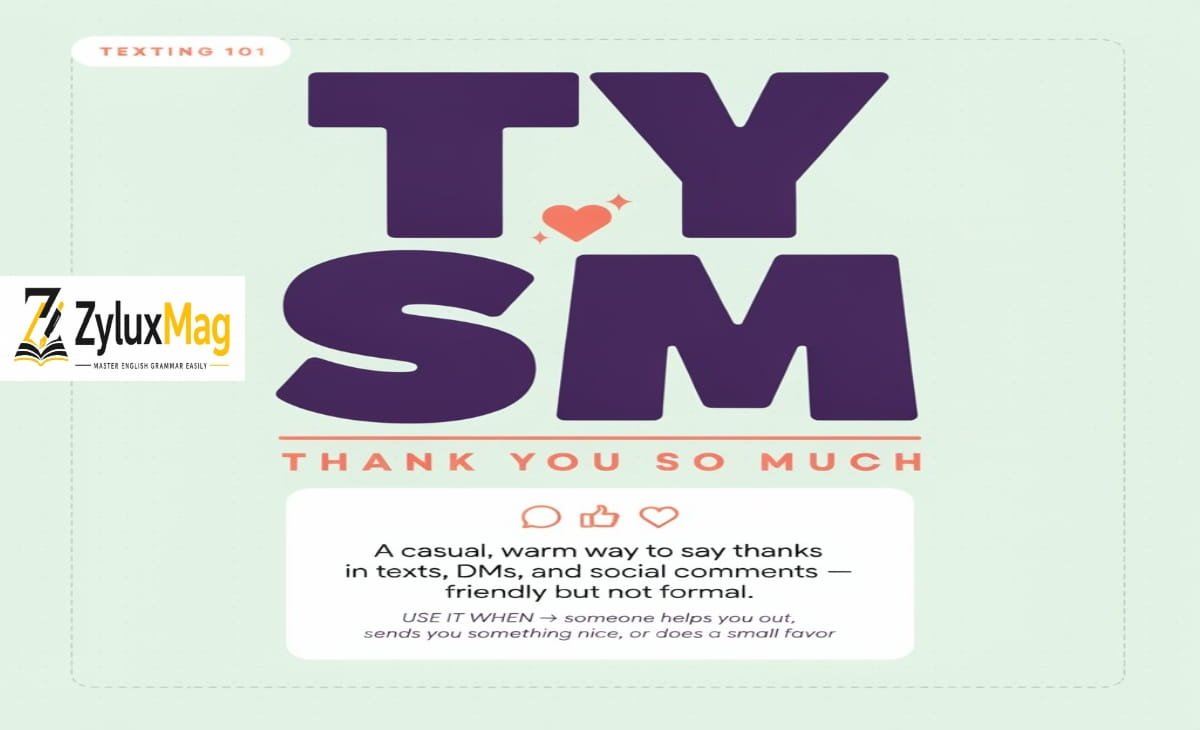
TYSM stands for “Thank You So Much.” It’s an informal initialism used in texting, social media, and online chat to express gratitude quickly and warmly. If you saw it in a message and wondered what it meant, that’s the whole answer — the sections below cover how to use it correctly.
What Does TYSM Mean?
TYSM is short for “Thank You So Much.” Each letter represents one word in the phrase:
- T – Thank
- Y – You
- S – So
- M – Much
It’s used the same way you’d use “thank you so much” out loud — to show appreciation that feels a little stronger or warmer than a plain “thanks.” You’ll see it in text messages, Instagram and TikTok comments, WhatsApp chats, Discord, and casual emails between friends.
Capitalization doesn’t change the meaning. TYSM, Tysm, and tysm all mean exactly the same thing — the difference is just style, not grammar.
Is TYSM an Acronym or an Initialism?
TYSM is technically an initialism, not an acronym. This distinction trips a lot of people up:
- An acronym is pronounced as a word (like NASA or LOL when said as “lol” rather than “L-O-L”).
- An initialism is read letter by letter, or in TYSM’s case, expanded back into the full phrase when spoken.
In practice, almost nobody says “T-Y-S-M” out loud. People just say “thank you so much.” So while it’s technically an initialism, its spoken form doesn’t really matter much in daily use — it exists to be typed, not said.
TYSM vs. TY vs. TYVM vs. THX — What’s the Difference?
TYSM belongs to a small family of “thank you” abbreviations. They all mean roughly the same thing but carry slightly different levels of warmth and effort.
| Term | Full Meaning | Tone | Best Used For |
| TY | Thank You | Very casual, brief | Quick replies, gaming chats |
| TYSM | Thank You So Much | Casual and warm | Texts, DMs, social media comments |
| TYVM | Thank You Very Much | Casual, slightly more polished | Everyday chats that feel a touch more polite |
| THX | Thanks | Very casual, fast | Quick acknowledgments, low-effort replies |
The main difference is intensity, not formality — none of these are appropriate for formal writing. TYSM sits in the middle: more expressive than “TY” or “THX,” but still fully casual.
Is TYSM Formal or Informal?
TYSM is strictly informal. It belongs in the same category as “LOL” or “BRB” — useful for fast, casual digital conversation, but out of place anywhere that calls for professional or polished writing.
Use TYSM when:
- Texting friends or family
- Replying to comments on social media
- Chatting in casual group chats, gaming lobbies, or Discord servers
- Messaging a coworker you’re friendly with, in a relaxed workplace chat culture
Avoid TYSM when:
- Writing a formal email, cover letter, or business correspondence
- Writing academic or professional documents
- Messaging someone you don’t know well, especially in a professional context
- Communicating with someone who may not recognize internet abbreviations, such as older relatives or non-native English speakers unfamiliar with texting slang
In formal writing, the natural substitute is simply: “Thank you very much” or “Thank you so much for your help.”
A Quick Story
The first time I actually thought about TYSM was after I sent it in a client email. I’d just wrapped a rushed project, typed “TYSM for the extension!!” and hit send before my coffee even kicked in. Ten minutes later, my client replied asking, genuinely confused, what “tysm” meant. I had to explain it was just “thank you so much” — and then spend the rest of the morning cringing about it. That one email taught me more about tone and audience than any style guide ever did. Now I always ask myself: would I say this out loud to this person?
TYSM in Real Conversations
Here’s how TYSM typically appears in context, compared with its formal equivalent:
Text message between friends:
“Omg you remembered my birthday, TYSM 🥹”
Social media comment:
“TYSM for 10k followers!! Couldn’t have done it without you all”
Casual workplace chat:
“Just sent the file over — TYSM for the quick turnaround!”
Formal email (what you’d write instead):
“Thank you very much for your prompt assistance with this request.”
Notice that TYSM is often paired with emojis or extra punctuation (“!”, “🥹”,”). This isn’t required, but it’s common — because the abbreviation itself is short and flat, people often add emotional cues around it to keep the warmth of the message intact.
Can TYSM Be Used Sarcastically?
Occasionally, yes — but this is the exception, not the rule. In the right context, TYSM can be used sarcastically to mean the opposite of genuine thanks, usually when someone is annoyed or pointing out that another person did something unhelpful or embarrassing.
Example:
“TYSM for telling everyone about my typo in front of the whole team.”
The sarcastic reading depends entirely on context and tone — there’s no spelling or punctuation difference that signals it. If you’re unsure whether someone meant it sincerely or sarcastically, the surrounding conversation is the only real clue.
In the vast majority of everyday use, though, TYSM is sincere and friendly formal vs informal email language.
Common Mistakes and Misconceptions About TYSM
“TYSM is brand-new Gen Z slang.” Not quite. Abbreviated “thank you” phrases like this trace back to early texting and internet chat culture, well before more recent slang trends. It’s simply stayed popular because it’s short and easy to understand.
“TYSM always means someone is extra grateful.” Not necessarily. While TYSM does read as warmer than a plain “thanks,” it’s often used out of habit in fast-paced digital conversation rather than to signal unusually deep gratitude. Don’t read too much extra emotion into it by default — context matters more than the abbreviation itself.
“TYSM is an acronym.” As covered above, it’s an initialism, not an acronym, since it isn’t pronounced as a single word.
“Capitalization changes the meaning or formality.” It doesn’t. TYSM, Tysm, and tysm are interchangeable — style preference only.
“TYSM means something different depending on the app.” It doesn’t. Whether you see it on Snapchat, Instagram, WhatsApp, or TikTok, TYSM always means “Thank You So Much.” Only the general tone of the platform (more playful vs. more personal) might change how it’s styled, not what it means.
Quick Answers
How do you pronounce TYSM?
You don’t spell it out loud — people simply say “thank you so much” when reading it aloud.
How should you reply to someone who says TYSM?
A simple “You’re welcome,” “No problem,” or “Anytime!” works well. Matching the casual tone (e.g., “np!”) is also common.
Is TYSM the same as “thanks so much”?
Yes — TYSM is just the typed shorthand version of “thank you so much,” with identical meaning.
About the Author
Faizan Babar writes about everyday English grammar, vocabulary, and internet slang for ZyluxMag. He enjoys breaking down casual, modern language — the kind you actually see in texts and DMs — into clear, practical explanations anyone can use with confidence.